
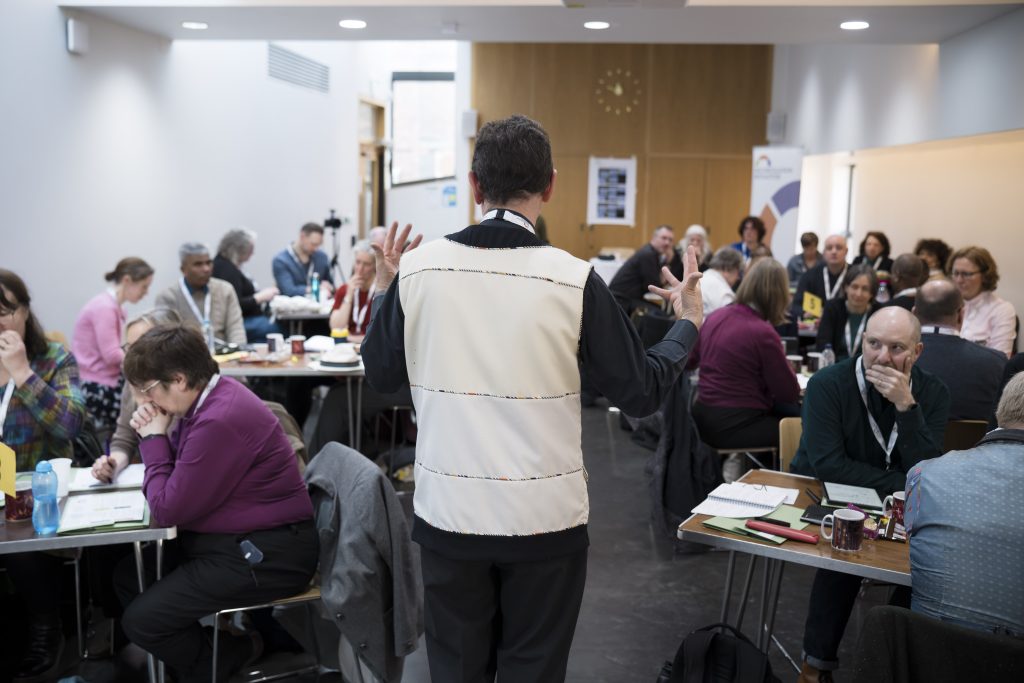
Over the past 18 months, clergy from the Dioceses of Bristol, Leeds, Lincoln and York – our 4th cohort – have completed the Reconciling Mission programme. This course helps participants reimagine traditional parish ministry through being more attentive one’s neighbours and what God is doing in the local community.
Programme participants gathered last week at Coventry Cathedral to mark the conclusion of the 4th cohort’s journey, and the mid-way point for the 5th cohort, from Durham, Newcastle and Southwark Dioceses.
For many, the programme has provided some sanctuary from the intense busyness of parish life. It has given essential headspace to move beyond survival and focus on the deeper questions about what “church growth” can look like in their localities.

The day’s keynote address was offered by Revd Dr Joshua Cockayne, Academic Dean at Cranmer Hall, Durham, who challenged those gathered to rethink the foundation of their mission. Speaking about the idea of “synodality,” Josh invited clergy to listen more deeply and adoringly to God, and from this centred place to enter into God’s missional activity by setting aside their churches’ preset growth agendas.
Drawing on the wisdom of the 20th Century mystic Evelyn Underhill, he warned against the “busy British approach” which treats prayer like a shopping list of needs.
“The foundation of listening is adoration of God,” Josh told the delegates. It is from this quiet and contemplative place, he argued, that Christians learn to listen: to the internal promptings of the Holy Spirit, to the congregation as the body of Christ, and to the prophetic voice of the wider community.
Hear a snippet of Josh’s talk here; or to the full presentation here.
This theme of attentive listening was a thread through the whole day as participants shared how the Reconciling Mission programme had positively impacted their ministries.
“When I was invited to join, I wasn’t quite sure what ‘Reconciling Mission’ actually meant,” Alison Sowton, a vicar from Bristol Diocese, said.
Alison and other participants discovered that it’s not about achieving a resolution to problems. Instead, it’s about entering into the ongoing work of God in restoring just-relationships, with the Godhead, inside the church, and with neighbours in the local community.
One valued aspect of the programme was the opportunity to step outside of one’s own context. Parish ministry can be isolating for clergy, who can feel pressure to have “the answers” for their churches. Yet, as many participants noted, breakthrough often came when in dialogue with peers who didn’t know the answers but brought short, powerful questions within a group coaching framework.
“What questions is God asking us to pose and respond to in conversation with our neighbours?” is one of the wider-scale questions explored through Reconciling Mission.
“The stories emerging from the programme are exciting,” said Rt Revd Anna Eltringham, Bishop of Ripon in Leeds Diocese, who had been a participant in an earlier Reconciling Mission cohort, and had advocated for her diocese to sponsor a group.
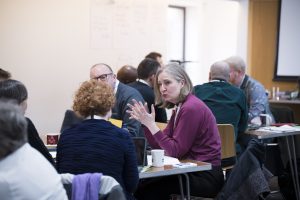
Hannah Hobday, a vicar in Leeds Diocese, shared how her church came to the realisation that they didn’t really know their own neighbourhood deeply. By shifting from focusing on trying to bring people into their church building, and being humbly willing to join in with what was already emerging, they eventually found themselves launching a café within a local community centre, in partnership with their neighbours.
Rather than producing a grand plan behind closed church doors, they moved to listen to people in their locality. They ended up moving from being the host, in charge of a space, to being the guest in another organisation’s space.
As the 4th cohort concluded, participants spoke of their faith being “brought alive” and a sense of “new life” being breathed into their churches through looking at their neighbours with fresh eyes and a humbler posture.
In a time of much-discussed congregational decline, the message from this conference was hopeful: God has not given up on our local communities. Indeed, the Spirit is actively at work among our neighbours, provided we learn to listen and notice this.
Watch a video of the day here
Contact Alastair McKay for information about your diocese joining cohort 6 here